
WakaPAC vs Vue vs React
Last updated: 2026-10-29
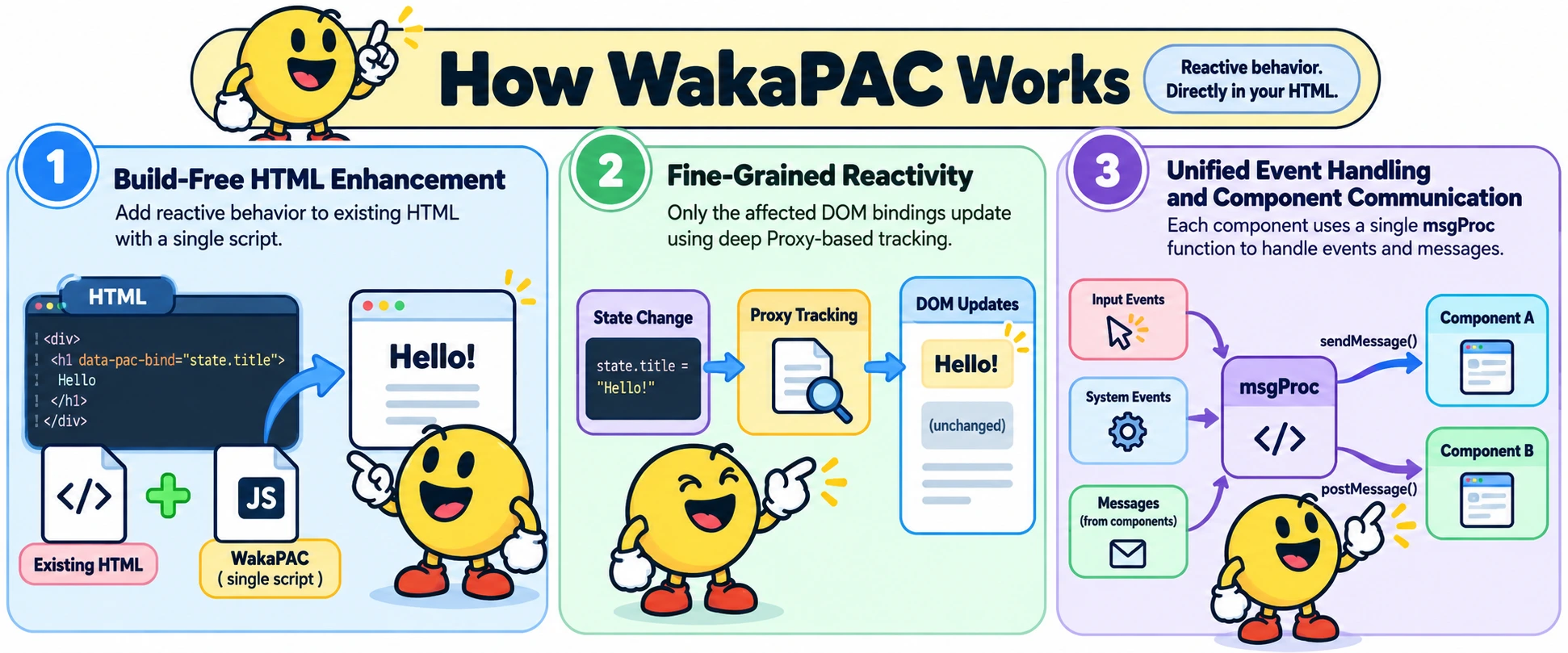
React and Vue both wrap your UI in a build pipeline — JSX or Single-File Components compiled down
into a virtual-DOM runtime. WakaPAC takes a different approach: it drops directly onto HTML you
already have, as a single script with reactive data binding and no compiler, no JSX, and no
virtual DOM standing between your code and the page. All three give you two-way-feeling data
binding and a component model, but WakaPAC adds something neither of them has —
msgProc, a single Win32-style message procedure that every input event and
cross-component message flows through.
At a glance
| Concern | WakaPAC | Vue | React |
|---|---|---|---|
| Category | Toolkit — binds behavior onto existing HTML | Framework — components, routing, build tooling | Library — components, with routing/state from the ecosystem |
| Build step | None, ever — one script tag | Not required to start (CDN + in-DOM templates); SFCs in real apps compile via Vite | Effectively required — JSX needs Babel/SWC |
| Template format | Plain HTML, data-pac-bind attributes, {{ }} interpolation |
HTML templates with v-* directives, usually in .vue files |
JSX — markup embedded in JavaScript |
| Reactivity model | Deep Proxy; updates the exact bound DOM node, no virtual DOM |
Proxy-based (ref/reactive) driving a compiler-optimized virtual DOM |
Virtual DOM; a state change re-renders the component and reconciles the tree |
| Event handling | msgProc — one Win32-style message procedure per component, plus click:-style bindings |
v-on directives (@click, @keydown.enter) |
Synthetic event props (onClick, onKeyDown) |
| Derived state | computed object, automatic dependency tracking |
computed(), automatic dependency tracking |
useMemo(), manual dependency array |
| Side effects | watchers, including async watchers |
watch() / watchEffect() |
useEffect(), manual dependency array |
| Component communication | sendMessage() / postMessage() between any two named components |
Props down, emit up, provide/inject for deep trees |
Props down, callbacks up, Context for deep trees |
| Shared / global state | WakaStore plugin | Pinia (or Vuex) | Redux, Zustand, or Context — not built in |
| Routing | WakaRoute plugin | Vue Router | React Router — not built in |
| Footprint | ~28KB, one file, the whole toolkit | ~34KB full build; smaller runtime-only build when SFCs are precompiled | ~45KB for React + ReactDOM together, before a router or state library |
| Ecosystem | A focused first-party plugin catalog, one mental model throughout | Nuxt, Vuetify, years of production use, big hiring pool | Next.js, an enormous package ecosystem, the biggest hiring pool |
No build step
React components are written in JSX, which is not valid JavaScript — it has to be compiled by
Babel or SWC before a browser can run it. An in-browser Babel exists for demos, but React's own
documentation doesn't recommend it for production, so in practice every React app ships through a
bundler. Vue is more flexible: its "full" build includes an in-browser template compiler, so you
can drop a <script src="vue.global.js"> tag on a page and write
v-bind/v-on directives directly in your HTML with no build tool at all.
Most real Vue applications still go through Vite for Single-File Components, routing, and
code-splitting, but the CDN path is genuinely usable for smaller pages.
WakaPAC works the same way every time: load wakapac.min.js, write
data-pac-bind attributes on HTML you already have, and the behavior is live — no SFC
format, no JSX, and nothing to compile, in a demo or in production.
What this means in practice
A server-rendered page — PHP, Rails, Django, WordPress, a legacy app — can get reactive behavior added to specific elements without introducing a JavaScript build pipeline at all. That's a different problem than "build a single-page app," which is what React and Vue are optimized for.
Reactivity: direct DOM updates, no virtual tree to diff
All three track dependencies automatically rather than asking you to declare them, but what happens after a change is tracked is where they diverge.
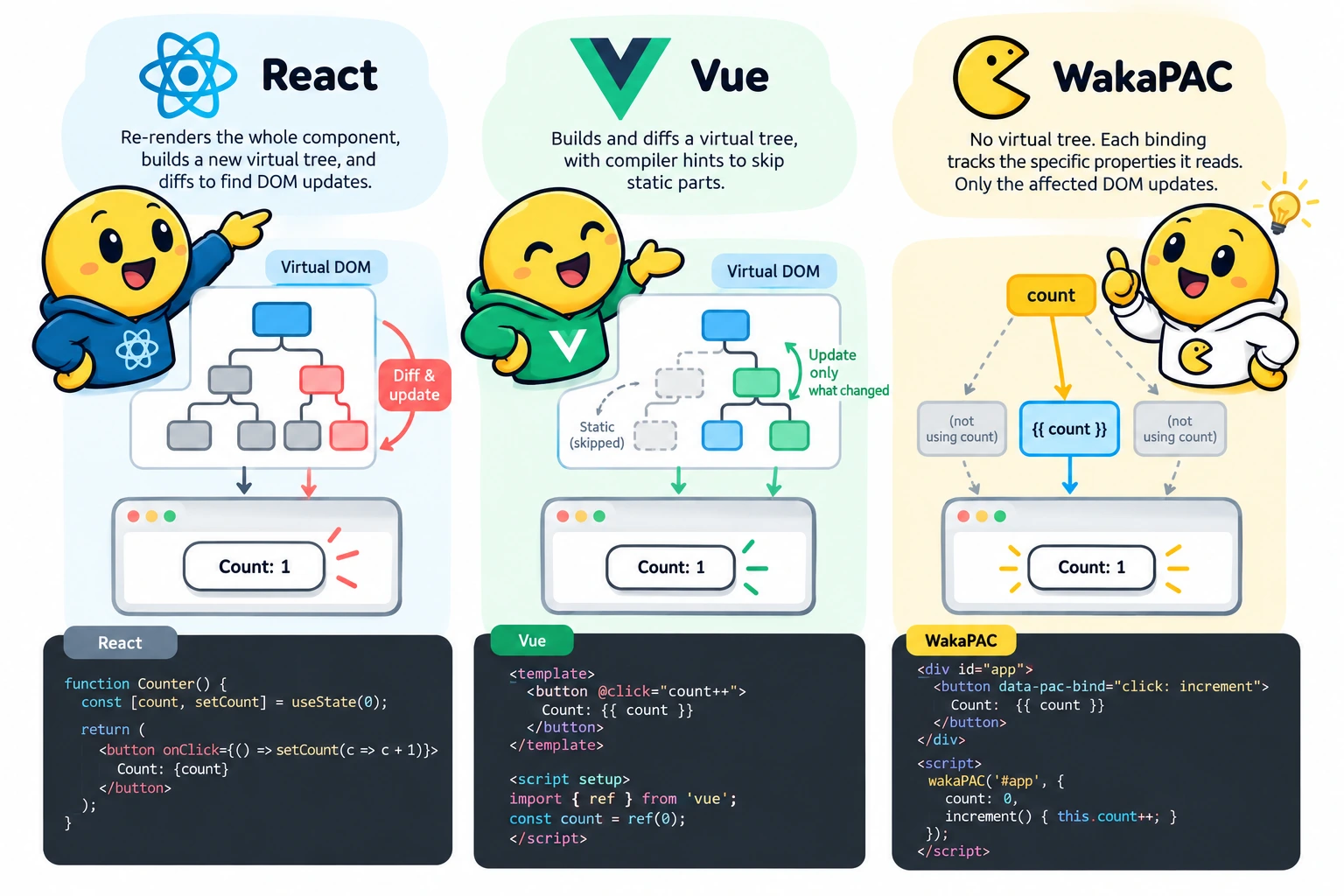
React re-renders the whole component function on a state change, builds a new virtual tree, and
reconciles it against the previous one to find the minimal set of real DOM updates. That model is
simple to reason about, but it means React has to do the reconciliation work on every update, and
a component tree that doesn't memoize carefully can re-render more than it needs to. Vue 3 also
builds and diffs a virtual tree, but its compiler annotates static parts of the template so the
runtime can skip them, and ref/reactive state is tracked by property —
closer to fine-grained updates than React's component-wide re-render, but still a tree diff
underneath.
WakaPAC skips the virtual tree entirely. Each binding in your HTML registers as a dependent of the specific properties its expression reads; when one of those properties changes, only that binding's DOM write runs, and only after a value-equality check confirms the value actually changed. There's no tree to diff because there's no tree — just a direct map from property to the DOM nodes that depend on it.
msgProc: the clearest differentiator
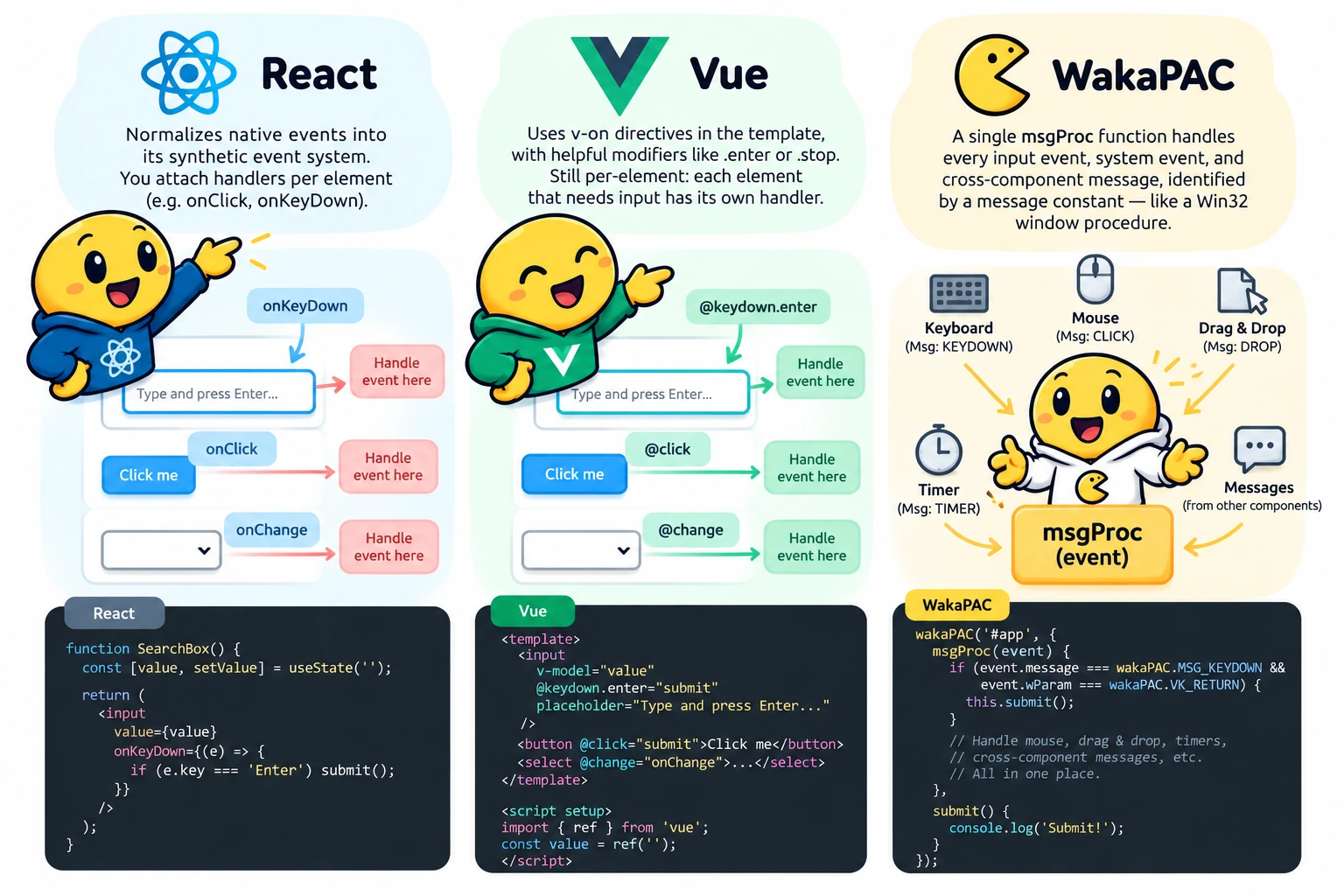
React normalizes native events into its own synthetic event system and hands them to you as props
on each element — onClick, onKeyDown, and so on, one handler per element
that needs one. Vue's v-on directives do the same job in the template, with
convenience modifiers like .enter or .stop for common cases. Both are
per-element: input handling lives wherever the element that needs it is declared.
msgProc takes a different approach, borrowed directly from Win32: a single function
per component that every browser input event, system event, and cross-component message flows
through, identified by a message constant exactly like a Win32 window procedure. The advantage
compounds as a component needs to coordinate more kinds of
input — mouse, keyboard, drag-and-drop, timers — because all of them arrive at the same function
instead of being spread across separate handlers on separate elements. It's also where WakaPAC's component
communication (sendMessage()/postMessage(), covered below) and most of
its plugin ecosystem plug in, so it ends up being the one mental model that carries across the
rest of the toolkit — not just an alternative event-binding syntax.
Derived state and side effects: tracked automatically, or declared by hand
WakaPAC's computed properties and Vue's computed() both analyze the
function body to find which properties it reads, and only recompute when one of those actually
changes — you never list the dependencies yourself. React's equivalent, useMemo(),
takes a dependency array you maintain by hand; get it wrong and you either recompute on every
render or miss a change and read stale data. The same gap applies to side effects: WakaPAC's
watchers and Vue's watch() track their own dependencies, while React's
useEffect() depends on a correctly maintained array and is a well-documented source
of stale-closure bugs when that array is wrong.
Component communication and shared state
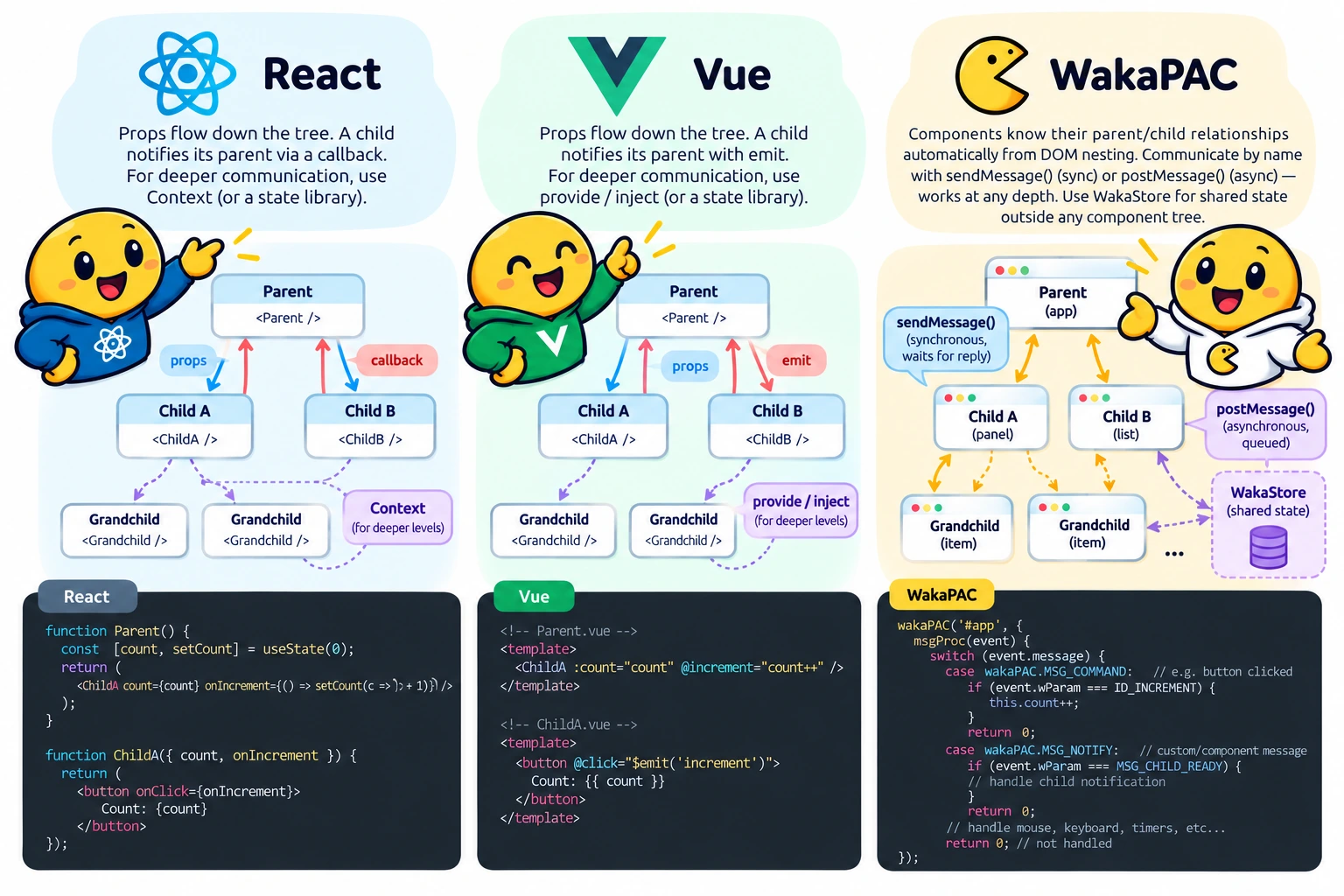
React and Vue both default to props down the tree, with a callback (React) or emit
(Vue) for a child to notify its parent. Reaching further than one hop means Context (React) or
provide/inject (Vue) — mechanisms that work, but that most teams reserve
for state that genuinely needs to skip levels, falling back to a dedicated state library
(Redux, Zustand, Pinia) once an application outgrows prop-passing.
WakaPAC components resolve their parent-child relationships automatically from DOM nesting, then
communicate by name with sendMessage() (synchronous, waits for the receiver's
msgProc to return) or postMessage() (queued, returns immediately) —
regardless of how deep the hierarchy is, with no separate context API to learn. For state that
needs to be shared outside any single component tree, the WakaStore
plugin plays the same role as Pinia or Redux.
Footprint
WakaPAC ships as a single ~28KB (minified + gzipped) file that already includes reactivity,
templating, msgProc, and component communication — there's nothing else to add for
those features. React's runtime is split across react and react-dom,
together roughly 45KB (minified + gzipped), and neither a router nor a state library is included,
so a comparable feature set costs more before your own components are counted. Vue's full build
(runtime plus in-browser compiler) is
roughly 34KB; applications that precompile Single-File Components at build time ship a smaller
runtime-only build instead, at the cost of needing that build step.
Ecosystem
React and Vue both have large package ecosystems behind them: meta-frameworks (Next.js, Nuxt), enormous component libraries, and mature dev tools built up over a decade or more. WakaPAC's catalog is smaller so far — official plugins for shared state (WakaStore), HTTP (WakaSync), routing (WakaRoute), forms (WakaForm), and integrations for canvas, charts, and media players.
What it doesn't have in size, it makes up for in consistency. Every one of those plugins is wired
through the same msgProc pipeline — the same message-based API you already use for a
component's own input handling. In React or Vue, each package in a much larger ecosystem tends to
bring its own conventions — hooks, composables, its own event model — so adopting a new one means
learning how that package wants to be used. With WakaPAC, learning msgProc once means
you already know how every official plugin works.
Which should you choose?
Reach for WakaPAC when you're adding reactive behavior to pages that are already rendered
server-side and don't want a build pipeline in the mix — and especially once a component's input
handling gets complex enough to benefit from msgProc's single, unified message
procedure instead of listeners spread across a template. If you're instead building a large
single-page application from scratch with a dedicated frontend team and build tooling already in
place, weigh that against React or Vue's larger ecosystems — routing, state management, component
libraries, and a bigger hiring pool.
Frequently asked questions
Is WakaPAC a replacement for Vue or React?
It depends on what you're building. WakaPAC is built for adding reactive data binding and desktop-style event handling directly to HTML you already have, with no build step. If you're enhancing an existing server-rendered page, that's WakaPAC's core job. If you're building a large single-page application from scratch, Vue or React's component and tooling ecosystem is built specifically for that.
Does WakaPAC require a build step like Vue or React do?
No, never. You load wakapac.min.js from a CDN or a downloaded script tag and
write plain HTML with data-pac-bind attributes — there's nothing to compile in
development or production. React effectively requires a build step because JSX isn't valid
JavaScript. Vue can skip one for simpler pages using its CDN "full" build with in-DOM
templates, but most production Vue apps compile Single-File Components with Vite.
Does WakaPAC use a virtual DOM like React and Vue?
No. React re-renders a component and diffs a virtual tree against the previous one; Vue does the same with compiler-assisted optimizations. WakaPAC has no virtual tree at all — each binding tracks the specific properties its expression reads, and a change updates only that binding's DOM node directly, after a value-equality check confirms something actually changed.
How does WakaPAC's msgProc differ from React's event handlers or Vue's v-on?
React's onClick/onKeyDown props and Vue's @click/@keydown
directives are both per-element — you attach a handler wherever the element that needs it is
declared. msgProc is a single function per component that every input event,
system event, and cross-component message flows through, identified by a message constant the
same way a Win32 window procedure works. It's most useful when a component needs to coordinate
several kinds of input in one place rather than scattering handlers across elements.
Does WakaPAC have something like Vue's Pinia or React's Redux?
Yes — the WakaStore plugin provides a shared reactive store that multiple components can read and write, with persistence and server sync, playing the same role Pinia plays for Vue or Redux/Zustand play for React.
Is WakaPAC production-ready?
Yes. The core — reactivity, data binding, msgProc, component communication — is
stable and actively maintained, with regular releases. Check the
release history
to see that activity for yourself.